Both in the lab and on the bike, senior Exercise Science major Ben Luna puts his passion for cycling to the test
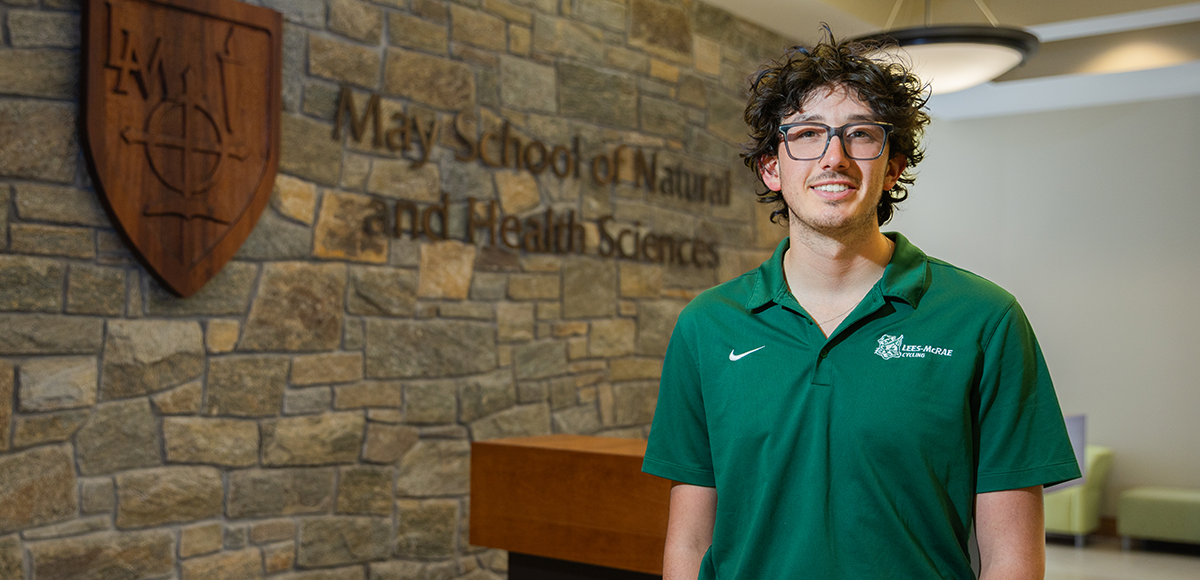
Senior Exercise Science major Ben Luna has long been a cycling athlete. He nurtured a passion for the sport throughout middle and high school and carried it with him to college where he competes on the Lees-McRae cycling team and is earning a minor in Cycling Studies.
Cycling remains a central force in his life, but it has also introduced him to another passion. One he has dedicated countless research hours to and hopes to develop into a career following graduation.
Over the past two semesters Luna has been working in collaboration with Program Coordinator and Instructor of Exercise Science Jordan Johnson to create the college’s first on-campus lab for testing athlete performance. What began as a course-required internship for his Cycling Studies minor has developed into his senior research project and a fully-fledged lab that can perform aerobic fitness testing on all kinds of athletes.
“It was kind of split into two big parts. The first part was opening the lab, which involved writing a bunch of policies, making emergency action plans, and creating a staff and personnel manual. Then the second part of it was actually designing this protocol for cyclists,” Luna said. “Eventually I decided on a battery-three test—which is a body composition test, a VO2 max test, and an isokinetic test—and then last semester we started testing cyclists.”
Since ironing out the testing protocols, Luna has been able to run this program with many of the athletes on the college’s cycling team, as well as athletes from Kelly Benefits Cycling Team, a USA Cycling Domestic Elite u23 team.
While the college’s cycling team has previously worked with Appalachian State University to run VO2 max and body composition testing on their athletes, Luna has brought such testing in-house for the first time and has expanded the Lees-McRae lab to include isokinetic testing abilities as well.
“I remember coming up through middle and high school as a cycling athlete and realizing there are people way better than me and people way worse than me. Why is that? That fascination just kept growing and growing, and then I got to college where I was part of a high-level cycling team and got to see that stuff up close,” Luna said. "With the lab I get to do this every day and it’s so much fun. It’s the exact thing that I’m super passionate about and really gets me going in the morning. I get to look under the hood of these elite athletes, and I get to test them and poke and prod them and understand why this athlete is really good in this domain and another athlete is really good in this domain.”
Luna has designed his testing protocol to do just that. The protocol involves three main tests: body composition, VO2 max, and isokinetic. To test for body composition, athletes are connected to a bioimpedance analysis machine, which sends a current through the body. Muscle, fat mass, and bone each have different levels of resistance to the current, so by analyzing the amount of time the current takes to travel through different parts of the body, researchers can understand how much of each category makes up an athlete’s body.
VO2 max testing is designed to understand cardiorespiratory fitness. VO2 max is the maximum amount of oxygen that one’s body can intake during a given period of intense physical activity. To determine this, athletes ride a stationary bike while wearing a special mask that measures oxygen intake and CO2 output. Throughout the test, the bike’s resistance increases until the athlete can no longer push the pedals.
Isokinetic testing is then conducted using a system called Biodex. Researchers control the speed and range of motion of a single joint, and measure the torque produced by that range of motion. In combination, these three tests can provide an understanding of how well an athlete’s strength training program is working and help identify areas for improvement.
“It’s one really big puzzle that’s really enjoyable,” Luna said.
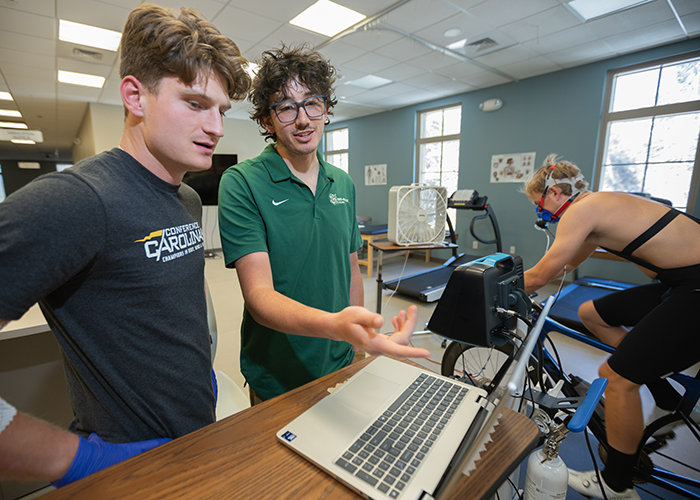
Luna, center, examines incoming data while an athlete undergoes VO2 max testing.
While the lab has been a venue for experiential learning for Luna, his work in developing this facility and testing protocol will carry a legacy far beyond his time at Lees-McRae. Johnson already uses the lab in many of his other Exercise Science courses, and he and Luna have created a plan to pass oversight of the facility to other students following Luna’s graduation this May.
“I’ve already identified a couple of people who have been in the lab with me through this process that Jordan and I feel are responsible, competent, and can take this challenge on,” he said. “The next big thing is that this is moving in the direction of a community outreach program. We’re poised as a performance center—so not necessarily longevity or general population stuff like App State does—but if you are a cyclist or a high-level runner or rower, we’re tailored for you.”
As he approaches Commencement, Luna has also been thinking about what’s next for himself. He plans to one day earn a master’s degree in exercise physiology and hopes to build a career working with high-level athletes and conducting tests like the ones he has pioneered here at Lees-McRae.