Conservation Heroes: Jesse Pope ’02
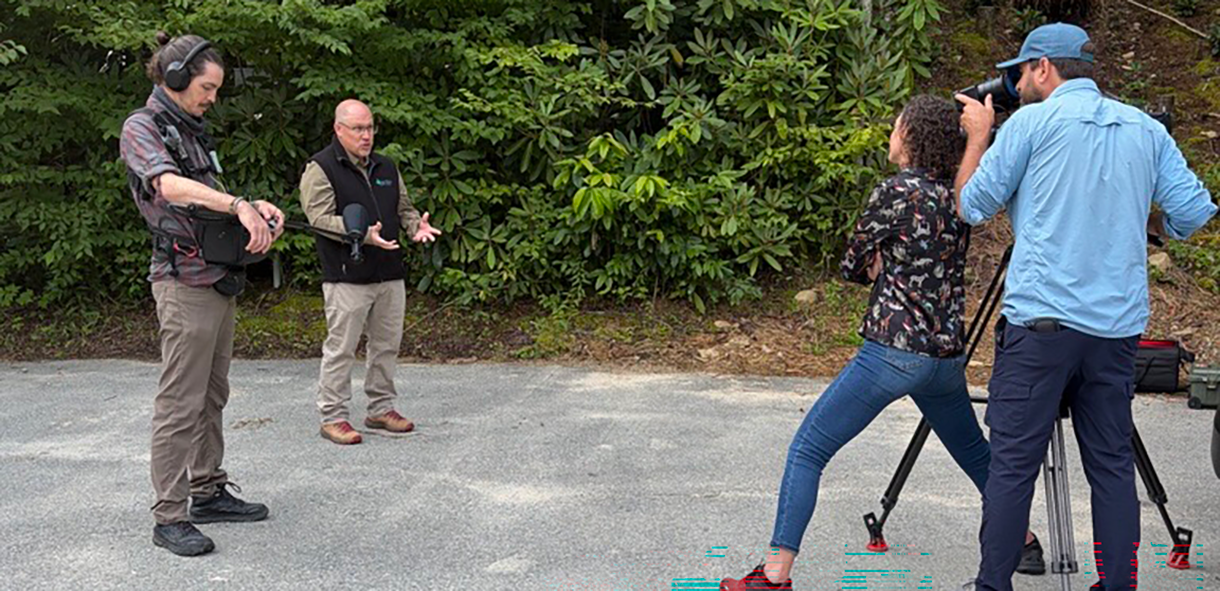
The first episode of “Jeff Corwin’s Southern Wild” debuts on ABC stations nationwide on Saturday, Oct. 3. Each episode features our Conservation Heroes—students, alumni, and faculty from Lees-McRae who share their experience with and expertise on the North Carolina wild with host Jeff Corwin.
Episode one features Jesse Pope ’02, who, along with Corwin, explores the lives and behaviors of synchronous fireflies on Grandfather Mountain. We talked with Pope about the show, his experience, and why conservation is so important:
What did you study as a student at Lees-McRae?
I earned a B.S. in biology with a naturalist concentration, which was a precursor to what is now the Wildlife Biology program. My time at Lees-McRae helped strengthen my interest in wildlife, ecology, environmental education, and connecting people with the natural world.
What is your current professional role?
I am president and CEO of the Grandfather Mountain Stewardship Foundation, the non-profit organization that owns and operates the Grandfather Mountain nature park. I have worked at Grandfather Mountain since May 2002 and have had the opportunity to serve in a variety of roles over the years, beginning as a seasonal naturalist and eventually moving into leadership. I have been leading the organization since 2015.
Our mission is to inspire conservation of the natural world through education, exploration, and example. Much of my work today is focused on ensuring that Grandfather Mountain and its extraordinary natural resources are protected while also creating meaningful opportunities for people to experience, understand, and care about the natural world.
Tell me about the topic you covered with Jeff on “Jeff Corwin’s Southern Wild.”
Jeff and I explored synchronous fireflies and Grandfather Mountain’s Grandfather Glows events, which give the public an opportunity to experience this remarkable natural phenomenon.
Fireflies are fascinating creatures in their own right, but synchronous fireflies are especially captivating because large numbers of males coordinate their flashes during their courtship displays. It is an incredible example of how even something as seemingly familiar as a firefly can reveal just how complex and extraordinary the natural world really is.
Grandfather Glows gives us an opportunity not only to share that experience with people, but also to educate them about firefly ecology, the habitats these insects depend upon, and the importance of protecting dark, healthy natural environments.
What is the most important thing for people to understand about this topic?
For me, the larger message is that extraordinary biodiversity is all around us, sometimes in places and species we might otherwise overlook.
North Carolina is an incredibly biologically diverse state, and programs like “Southern Wild” provide an opportunity to introduce people to some of those remarkable natural resources and to the organizations, scientists, and conservationists working to protect them.
Synchronous fireflies are a wonderful example. Most people have memories of seeing fireflies in their backyard as children, but when you begin to understand their biology, their communication, and the environmental conditions they depend upon, something familiar suddenly becomes extraordinary. That sense of wonder can be a powerful starting point for conservation. We tend to protect the things we understand, appreciate, and ultimately care about.
How do you feel that the work you do makes you a Conservation Hero?
I’ve been fortunate to work alongside many people throughout my career whom I consider true conservation heroes, so that is a title I accept with a great deal of humility.
My career has given me the opportunity to advocate for Grandfather Mountain and its extraordinary biodiversity, but I think perhaps the most meaningful part of my work is helping people develop their own connection to this place and to the natural world.
Grandfather Mountain has an incredible ability to create those connections. Someone may come here to walk across the Mile High Swinging Bridge, see a bear, hike a trail, experience fall color, or watch synchronous fireflies, but somewhere along the way, they can develop a deeper appreciation for the natural world.
I believe one of the most important things we can do in conservation is create opportunities for people to fall in love with nature. Knowledge is important, science is essential, and protecting habitat is critical, but conservation ultimately depends on people caring enough to act.
I’ve had the privilege of spending my career helping protect a remarkable mountain while also helping hundreds of thousands of people experience it each year. If those experiences inspire people to care a little more deeply about Grandfather Mountain, wildlife, and the natural world around them, then I feel like we are accomplishing something that can extend far beyond the boundaries of the mountain.