Hakim Bellamy ’02 shows how embracing the unfamiliar helps make a better artist
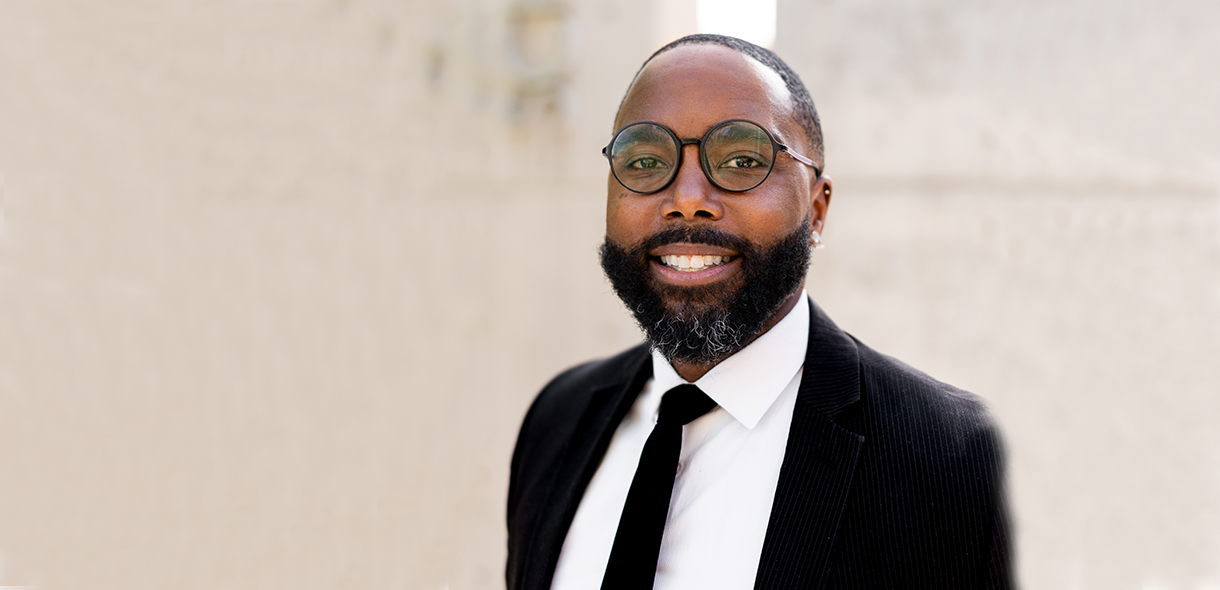
For Hakim Bellamy ’02, a prerequisite for being a great artist is living a life worth making art about. Bellamy has a wealth of professional experience in various fields, but his most enduring occupation has been as a poet, an artistic endeavor he has found a way to weave into his life at every stage.
Bellamy moved to Albuquerque, New Mexico after graduating from Lees-McRae with a Bachelor of Science in biology and a minor in communications, and the city has defined much of his professional and personal development since. The roots of his passion for poetry trace back further, however, to the first time he watched a slam poetry VHS tape as a student at Lees-McRae. Although Bellamy had been writing for as long as he could remember, this experience was eye-opening for him as a young artist.
“I saw there were actually people out there writing things like what I write,” he said. “They weren't quite raps what I was doing—they didn't need music—but they also weren't Robert Frost or E.E. Cummings. I didn’t quite know where I fit in the literary world until I saw these, essentially, slam poems. That was the first time I had seen a glimpse of, ‘I can do this.’”
Although his love for the artform had been cemented, Bellamy didn’t begin to build a life around his work right away. In Albuquerque he worked as a part-time assistant soccer coach and a microbiologist for a pharmaceutical company—"I wore a lab coat every day; it was kind of fun.”—before eventually applying to earn his Master of Arts in Communication and Media Studies from The University of New Mexico.
From there, his poetry career took off at warp speed. Bellamy began his graduate program in January, was named City Slam Champion by April, and won the National Poetry Slam by August, titles that helped him earn nationwide recognition.
Eventually, though, growing familial responsibilities and becoming a father brought him back to Albuquerque and into a “straight job” which he believed would be the best way to provide for his son. But even then, poetry called him back, and in 2012 he was named the inaugural Poet Laureate of Albuquerque.
“I was trying to work my straight job, and raise my child, and say, ‘I'm no longer going to be an artist,’ because it's just hard to do that and be a single parent. But when I got named Poet Laureate of Albuquerque in 2012, it was like, ‘All right, universe. I’m trying to run this way and you're making me run back this way, so I'm just going to run that way.’ I quit my job, and for 3 years I was a full-time artist. I was on the road, and I was touring, and I had support from my son's mother, I had support from my family and friends. I'm grateful to my village and my community who were like, ‘Do it, dude.’”
At the beginning of his career Bellamy’s work focused primarily on the personal. If he was in love, he wrote a love poem. If he was heartbroken, he wrote a piece on heartbreak. While he still often creates work that focuses on his unique perspective, he said that in his early work he struggled to dive into the deeper, nitty-gritty aspects of his experience.
“I learned that the deeper I write about something I’m feeling and experiencing, the broader its appeal. If I can get into that level of granular detail, it actually makes the poem more universal. It gets really good when people who don’t look like you, people who don’t have the same experience as you, can relate to it and see themselves in your very specific, very personal work,” Bellamy said. “I was writing poems about my weird experience and perspectives on the world and the things around me, and it resonated with 80-year-old New Mexican grandmothers, and 10-year-old white kids. We are more alike than we are different. That to me is the real magic and power of good art.”
To tap into that level of relatability, he says, the artist must first live a life connected to the world and to the people around them. Although he is no longer a full-time artist—Bellamy served a four-year tenure as deputy director of arts and culture for Albuquerque and recently graduated from law school and has begun practicing in the same city—he said his creative work fuels his mission in a corporate setting and vice versa.
“I look at my actual practice—the practice of law—and the only advantage that I had going in as a poet was the ability to see things from many different perspectives; the ability to be comfortable with knowing that there's not always a right answer,” he said. “Artists necessarily see the world beyond the duality, because if you’re a playwright you can't put yourself in other people's shoes unless your mind and heart is open enough to see things from other people's perspectives. I feel like the only advantage or skill that I brought to law school was that I was already doing that as a poet. I was already looking at the permutations, the possible things people might do, people might say, in various situations.”
Although the path to where he is now wasn’t always a direct route, Bellamy draws a clear line connecting the version of himself who watched that first slam poetry VHS as a young college student to the experienced artist and professional he is today. Much of which, he said, traces back to his time at Lees-McRae.
One day, early in his time at the college, Bellamy called his mom to express his homesickness. He grew up in Philadelphia and first attended Virginia Commonwealth University in Richmond, Virginia before transferring to Lees-McRae. Most of his life had been spent in bustling cities, and he felt like a fish out of water, but his mother encouraged him to embrace the unfamiliar experiences that would expose him to new things and ways of thinking. She emphasized that these are just the kind of lessons necessary for young people to find themselves.
“The greatest influence from Lees-McRae on my life was how I learned so much there about myself. I learned so much at Lees-McRae about who I wanted to be and how I wanted to show up in the world as opposed to just being the thing I thought I was supposed to be, or looking how I was supposed to look, or sounding how I was supposed to sound,” Bellamy said. “I think that’s a lot of what allowed Albuquerque to pick me as their first Poet Laureate, because I don’t look like a lot of people here, but they were like, ‘He’s more curious than scared. He’s curious enough to want to learn, and humble enough to want to be taught. You can see that in his work, and we like it.’”