Conservation Heroes: Riley Morris ’26
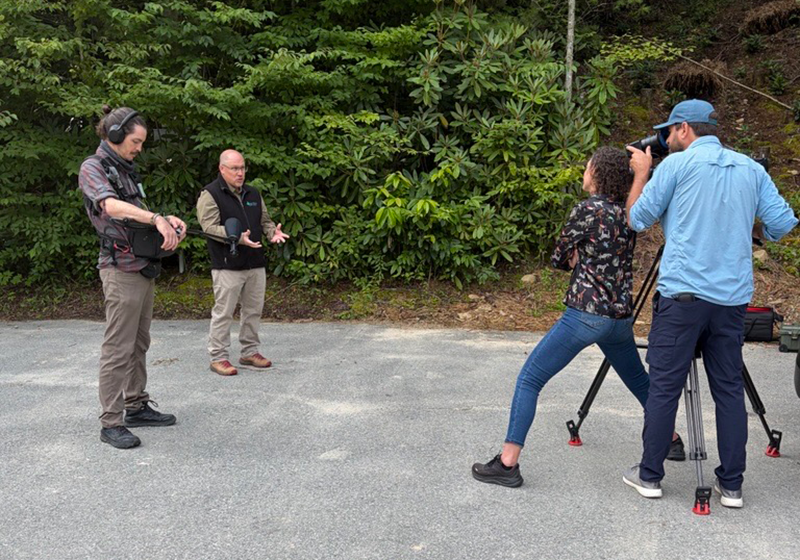
This Saturday, Oct. 10, episode two of “Jeff Corwin’s Southern Wild,” “Wildlife After Dark,” takes conservationists and viewers on a nighttime search through the forest for all manner of creatures, from reptiles to amphibians to insectivores.
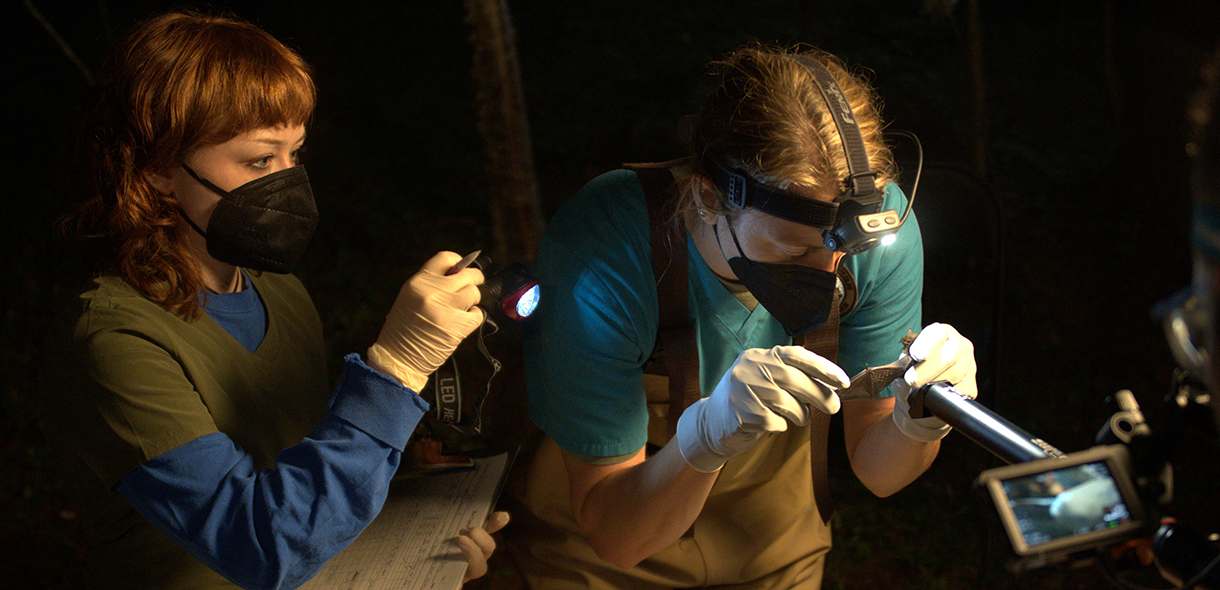
Wildlife Biology graduate Riley Morris ’26 joins host Jeff Corwin at a nighttime study on little brown bats, where they surveyed the local population to better understand how to protect them from white-nose syndrome. We talked with Morris about the show, her professional and academic experience, and why conservation is so important:
What did you study as a student at Lees-McRae?
I studied Wildlife Biology with a specialization in Field Biology.
What is your current professional role?
Currently, I am a seasonal gate attendant for the Indiana Department of Natural Resources. I sell park admissions, campsite reservations, and boat passes at Lake Monroe in Bloomington, Indiana.
Tell me about the topic you covered with Jeff on “Jeff Corwin’s Southern Wild.”
In my episode of “Jeff Corwin’s Southern Wild,” I got the opportunity to speak about bat conservation and survey methods. I got to tag along with the North Carolina Wildlife Resources Commission (NCWRC) to help survey the local bat population via mist net surveys. These surveys utilize large and thin “mist nets” stationed along a corridor where bats are likely to fly. Bats fly into these nets, then, biologists gently remove them to later take data and measurements from each individual bat. These include things like species, sex, age, reproductive status, and measurements of different anatomical features.
During the episode, I assisted by keeping an accurate log of data collected from each individual bat. Field surveys such as these are great opportunities to see elusive animals like bats up close and personal, however, they are also integral to gaining an understanding of the health and diversity of bat populations. Having a better understanding of our local bat populations will allow researchers to best know how to support their conservation.
What is the most important thing for people to understand about this topic?
Many people think that bats are dangerous, bloodthirsty pests, however, this is far from the truth. Bats save the U.S. agriculture industry over 3.7 billion dollars a year through their role in insect suppression. Most insectivorous bats can eat over half of their body weight in insects each night! They are nature’s pest control and should not be overlooked.
Insectivorous bats benefit human health by limiting insect populations which may carry disease. If you are still afraid of bats, just know that only 3 of the 1,500+ species of bats are vampire bats, and none of these bloodsucking species are found in the United States, nor do any target humans. Less than 1% of bats carry rabies, and most species only feed on insects or pollen. Bats should not be feared, instead, what is more scary would be a world without bats and the benefits they bring to the environment.
How do you feel that the work you do makes you a Conservation Hero?
It is amazing to have the opportunity to educate the public about the importance of such overlooked species. Bats are often seen as pests or as villains in horror movies, but instead they greatly benefit our environment. I plan to continue helping with bat research and would love to one day be a bat biologist. Though if I could change just one person’s perception of bats, then I’d definitely consider myself a Conservation Hero. Being a conservation biologist is my career goal, but the small steps I can make in public perception through outreach are just as important to me.